
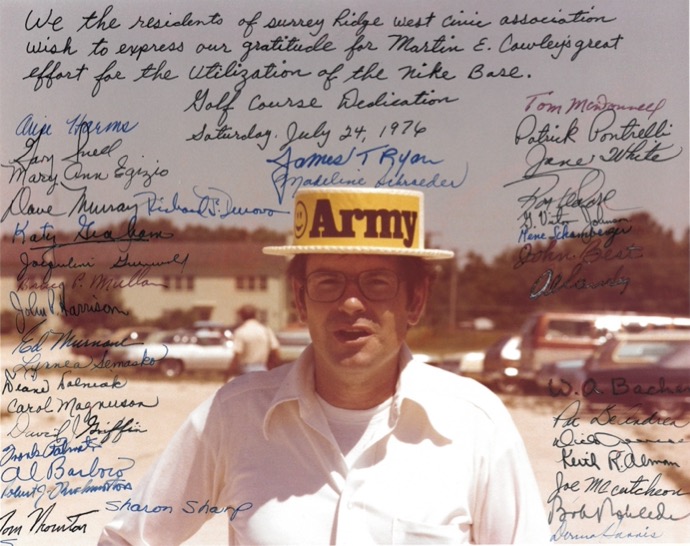
Marty Cawley served two terms as an Arlington Heights village trustee, back in 1977 to 1985. Among his priorities was bringing Lake Michigan water to the village as well as working with the local flood control committee to solve flooding issues.
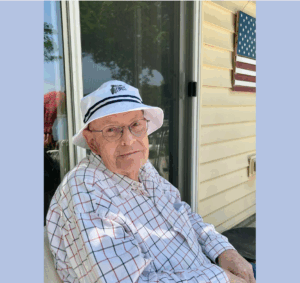
Marty Cawley
Ironically, it was that desire to solve flooding in his Surrey Ridge West neighborhood of Arlington Heights that ultimately propelled him into public service.
Cawley passed away peacefully Nov. 17 but his role in working with the U.S. Army to obtain land formerly used to store missiles — and ultimately developed as Arlington Lakes Golf Club — survives him.
Cawley and his family moved to the Surrey Ridge West neighborhood in 1971, one year after it was built. Almost immediately, the neighborhood — located south of Central Road, east of Wilke Road and north of Algonquin Road — began to experience flooding.
“Although my father’s home itself never flooded, the water came all the way up the street on both sides of him,” says his daughter, Beth Giarelli, a retired civil engineer with IDOT. “Basically, they needed an area to hold the flood water until it could be pumped into Salt Creek.”
Residents of Surrey Ridge West signed a photo of Cawley to thank him for his efforts.
Shortly after Cawley moved in, he was elected president of the Surrey Ridge West Civic Association. In brainstorming for ways to solve the flooding, he and his neighbors — Vic Johnson and Tom McDonnell — formed the Committee for the Utilization pf the Arlington Heights Nike Base.
Together, they conceived the idea of approaching the Army about converting some of its land used for the Nike base — located at Central and Wilke roads — to absorb some of the flood water.
“They asked the Army for land for detention ponds for the flood water,” his daughter says, “and then decided to incorporate a golf course on the land for the park district. The deep lakes at Arlington Lakes were built for the flood water.”
The group first approached their local Congressman, Rep. Phil Crane, with the proposal. Ultimately, Cawley, Johnson and McDonnell traveled to Washington D.C. to meet with Army brass and they made it all the way to the White House and the desk of President Gerald Ford to stake their claim.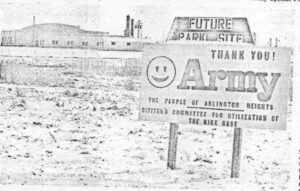
Village residents backed their proposal, with bumper stickers and even picketing at the Army site. Eventually, the Arlington Heights Park District was granted the land and in 1976 they dedicated the site. Arlington Lakes opened as a 90-acre municipal golf course in 1979 and has enhanced the village’s quality of life ever since.
That’s the way former Arlington Heights Mayor Tom Hayes describes it. Although his terms as trustee and president never overlapped with Cawley’s, he dealt with him many times in village matters.
“I always found him to be a man of very strong opinions and convictions and one who unceasingly pursued what he thought was in the best interests of the village,” Hayes says. “He was certainly among those who had a vision of what Arlington Heights should become, back in its formative years.”
In fact, the activism of Cawley, Johnson and McDonnell would lead all three into greater involvement with the village of Arlington Heights. One year after Arlington Lakes was dedicated, Cawley would be elected to his first term as a village trustee. Johnson would go on to serve as a trustee with the Arlington Heights Memorial Library, for more than 30 years, while McDonnell worked with the Arlington Heights Historical Society to organize the annual Irish Fest on its grounds.
“The golf course was an improvement for the whole village,” his daughter, Beth Giarelli, says, “however, my dad never actually golfed a day in his life.”
Other News: