What started out as an employee picnic and boat ride for Western Electric employees in Chicago, turned tragic in a matter of minutes. On July 24, 1915, the S.S. Eastland rolled onto its side while still tied to the dock along the Chicago River, leading to the loss of 844 passengers and crew.
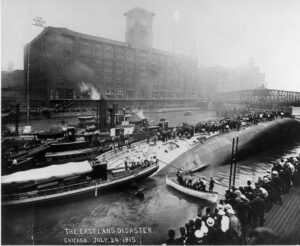
The Eastland after it overturned on July 24, 1915.
In fact, more passengers died aboard the Eastland than aboard the Titanic — which lost 832 passengers and another 635 crew — yet the tragedy remains one of the least-known maritime disasters in American history.
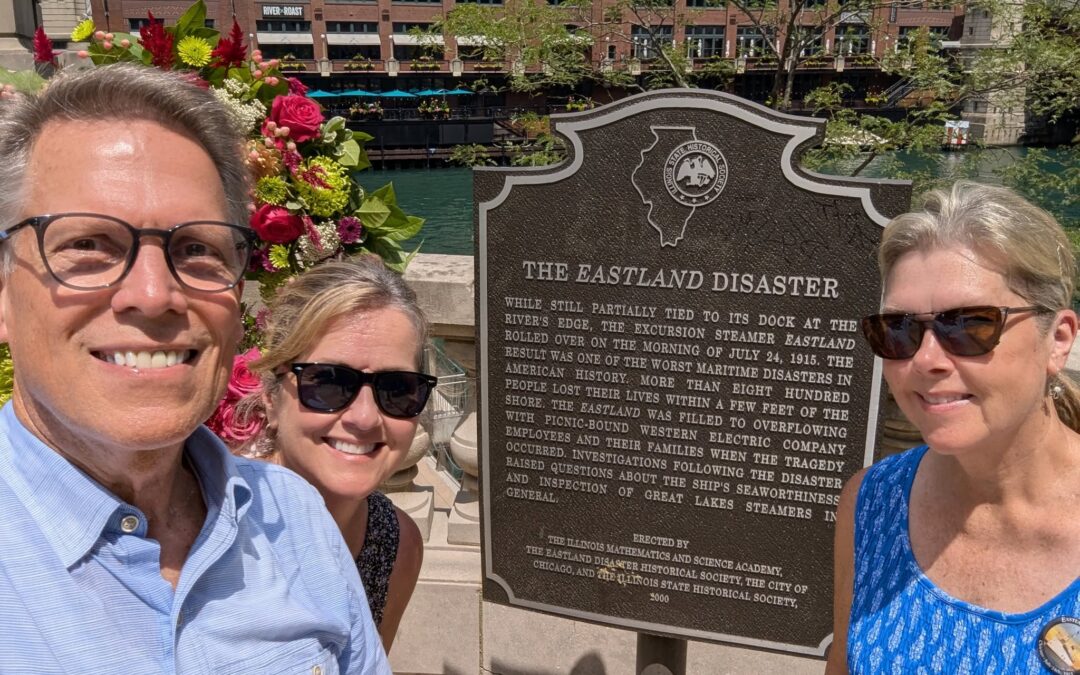
For the last 28 years, Ted and Barb Wacholz of Tower Lakes, as well as Barb’s sister Susan Decker of Lake Barrington have remained committed to keeping the memory of the Eastland disaster alive. In 1998, they formed the Eastland Disaster Historical Society, in order to create lasting legacies for the victims, survivors, heroes and anyone affected by the tragedy.
Their robust website features photos, historical documents, a people search and artifacts that comprise the history of the Eastland Disaster.
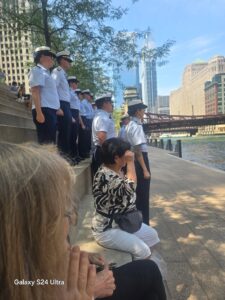
Members of the U.S. Coast Guard stand at attention during last year’s ceremony.
One of their solemn rituals every year is to hold a remembrance ceremony at the exact spot where the disaster took place. Consequently, on Friday, July 24 — the 111th anniversary of the disaster — the Eastland Disaster Historical Society will remember the victims from noon to 12:30 p.m. along the Chicago Riverwalk at Clark Street. The commemoration will feature a U.S. Coast Guard tribute, as well as descendant authors and historic reflections.
Look for sisters Barb Wacholz and Susan Decker to share some reflections. They are the descendants of survivor, Borghild “Bobbie” Aanstad, who was 13 when she boarded the Eastland, with her mother, Marianne Aanstad, and younger sister, Solveig, as well as their Uncle Olaf, a Western Electric employee. When tragedy struck, they all were thrown into the water, but all would survive since they were capable swimmers.
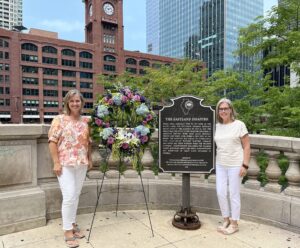
Barb Wacholz, left, and Susan Decker, both descendants of a survivor.
“We continue to be passionate about educating the public about the Eastland disaster because it’s all about creating legacies for ordinary people, including their names, faces and stories,” says Ted Wacholz, who serves as executive director and chief historian of the Eastland Disaster Historical Society.
“Every year we gather at the exact site where history unfolded because these lives deserve to be remembered,” Wacholz adds. “They won’t be forgotten if we keep saying their names and sharing their stories.”
Other News: