Dear SuburbTalk readers: This is the latest in a series of stories written by Jon Gardner, Assistant Curator of the Arlington Heights Historical Museum. Each month, he previews a new display at the museum. In November, the featured exhibit shines a light on Henry Müller, who played a prominent role in early Arlington Heights, with little recognition.
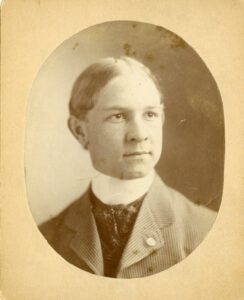
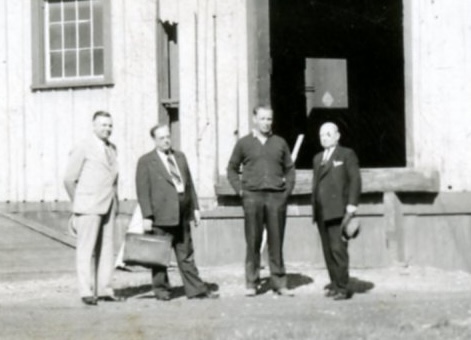
Henry Müller
As with our homes and their unseen, load-bearing walls, each community has unseen pillars holding it up. Henry Müller was such a pillar in Arlington Heights. While his father Fredrick was a visible public pillar as the founder of the thriving Arlington Club Beverage company who would serve a mayor, Henry was the inheritor of the business whose local political career was as a runner-up, rather than the lead.
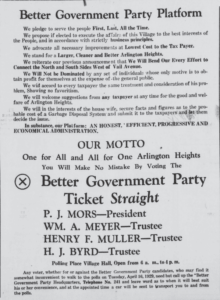
In 1929, he ran for Village Trustee under P. J. Mors’ mayoral ticket, winning his seat in support of Mors. When Mors decided not to run for re-election in 1931, Henry attempted to succeed him, only to lose to Julius Flentie. Henry would run, and lose, again in 1941. During World War II, he would be a vice-chair on the Civilian Defense Council under Homer Byrd. In 1945, after 22 years of co-owning the company he inherited with his brother William, Henry would sell the soda business his father had founded and built more than 70 years earlier.
And yet, despite seemingly destined for a supporting role, Henry Müller proved to be an unseen load-bearing wall without whom the institutions of Arlington Heights could not stand. As a member of the First Presbyterian Church, Henry took over managing the church’s nearly $50,000 in debt at the height of the Great Depression, that threatened to force the church into foreclosure. Over the next decade of skillful negotiation and fundraising, Henry pulled the church completely out of debt by 1946.
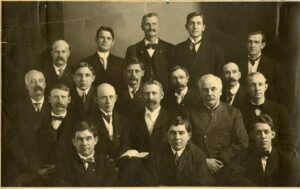
Müller, far right in second row, with members of the First Presbyterian Church of Arlington Heights
Similarly, in 1944, he led the local Boy Scouts in fundraising, bringing in more than $1,500, a record amount, 99% of which stayed with the local troops. During the war years, he would take on the thankless role of Air Warden Staff Officer. In that role, Henry organized each neighborhood’s air wardens in enforcing blackout rules — often unpopular — as well as coordinating Arlington Heights’ blackout procedures with the rest of the Chicago metropolitan area. Along with Byrd, he convinced a budget-conscious village, led by his 1941 opponent, Albert Goedke, to update the 1925 air raid siren system.
Henry rarely got acclaim and glamor that those around him, especially his father and brother-in-law received. Even today at the museum, where I work in his apartment, we focus on celebrating “Pop” Müller and Nathaniel Banta, often giving only passing reference to Henry.
On our tours, his mother Elise and sister Minnie get more shine. Yet Henry, like a load-bearing wall in my house, was no less important to the structure of Arlington Heights even if he was often unseen. This month, in our Gift Shop Case, we’re shining a light on this unseen community pillar, celebrating a man who often bore the weight of the community without the recognition.
Other News: