Dear SuburbTalk readers: This is the lates in a series of stories written by Jon Gardner, Assistant Curator of the Arlington Heights Historical Museum. Each month, he previews a new display at the museum. In September, the featured display will depict the life and confinement of Julie Hinds Wright, who with her family, survived being detained in the largest Japanese civilian internment camp during World War II.
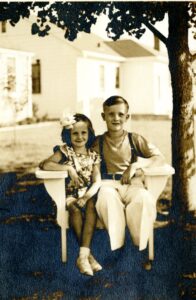
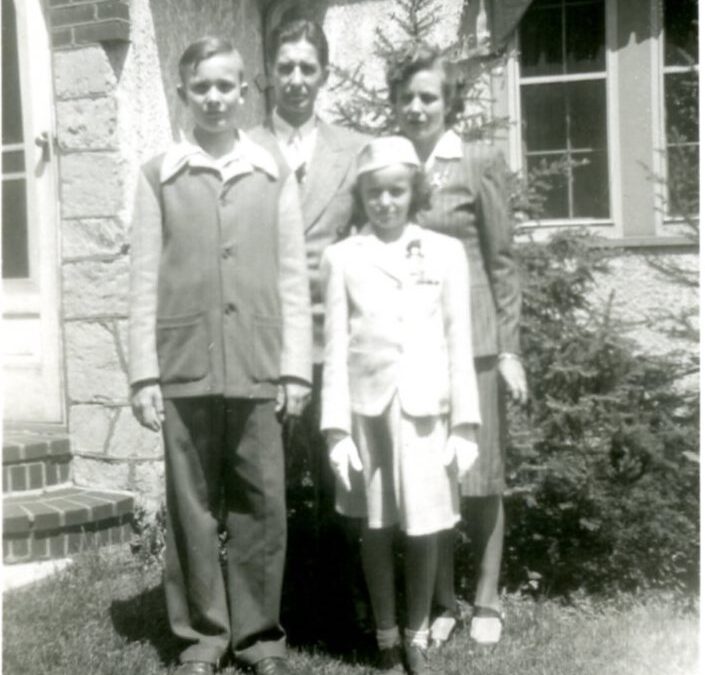
Julie Hinds and her brother, Robert, in 1941 in Manila, before their family was detained.
Most people think of a university campus as a place of discovery, debate and the excitement of young adulthood. But for 6-year-old Julie Hinds, the University of Santo Tomas in Manila, in the Philippines, was a different kind of school entirely.
It was a prison camp where “extracurriculars” meant surviving on meager rations and hoping for a tomorrow that felt increasingly out of reach.
Julie was one of approximately 4,000 Allied civilians — men, women and hundreds of children — interned by Japanese forces within those university walls for three years. It is a chapter of World War II often overshadowed by battlefield headlines, but for those who lived it, it was a constant, grueling test of the human spirit.
Julie and her family came to be in Manila because of a job transfer for her father, Lonnie. He worked for International Harvester and was posted in Manila in 1941, in the accounting department. They were interred for being American citizens in a case of “wrong place, wrong time.”
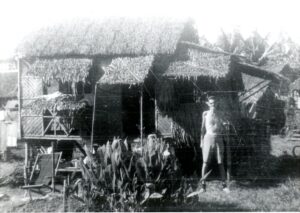
Santo Tomas internee, in 1945 before being liberated
At the university, the internees at Santo Tomas didn’t just sit in silence; they carved out a fragile existence, attempting to maintain structure through schooling and community life, even as they faced starvation, disease and the looming threat of the war’s final days.
The nightmare finally broke on Feb. 3, 1945. It was the 1st Cavalry Division — the famous “Flying Column” — that smashed through the camp’s gates, signaling the end of the long confinement. For young Julie, that liberation didn’t just end a war; it set a trajectory for the rest of her life.
After the war, Julie and her family settled in Arlington Heights when her father was moved to the Farm Equipment Research and Engineering Center, located in Burr Ridge, as an accountant. He rose to become the division comptroller for the farm equipment group.
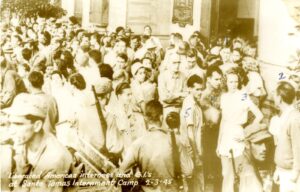
Santo Tomas, on the day of liberation
Julie herself graduated from Arlington High School in 1952, went to Wellesley College and came back around 1957 when she married Don Wright.
When we look at Julie’s later life in Arlington Heights — her relentless drive as a “professional volunteer,” the way she dedicated thousands of hours to the Senior Center, the tax prep, the computer literacy classes — it is impossible not to see the echo of those three years in Manila.
Having survived the worst of what humanity can do to one another, she chose to spend the decades that followed proving what humanity could do for one another.
The next time you’re at the museum, look past the artifacts and see the spirit of resilience behind them that was forged in one of the darkest places during the darkest time.
Stay Curious.
References
● “The Child Prisoners of Santo Tomas,” The National WWII Museum, https://www.nationalww2museum.org/war/articles/child-prisoners-santo-tomas
● “Santo Tomas Raid,” 1st Cavalry Division Association, https://1cda.org/history/santo-tomas-raid/
● Lonnie Hinds Diary
● Personal Correspondence

Other News: